
California’s Cap-and-Invest Program Should Not Have Been Expected to Fully Fund SB 840 Priorities
In recent months, recipients of Greenhouse Gas Reduction Funds (GGRF) have expressed concern that their priorities will be underfunded by the Cap-and-Invest Program compared to the full funding that stakeholders have described as having been “promised” or “committed” under last year’s agreement on legislative extension.[i] However, SB 840 itself does not guarantee full funding. To the contrary, the statute expressly anticipates the possibility that Tier 3 priorities will be underfunded: if available revenues are insufficient after higher priority allocations are made, then Tier 3 appropriations are reduced proportionally.[ii]
Separate from the statutory question discussed above, was full funding of SB 840 priorities reasonably supported by expected program revenues when it was extended last year? Full funding would require ~$4.35 billion of annual GGRF in FY 26-27.[iii] As Figure 1 shows, historical revenues exceeded that level only twice, in FY 21-22 and FY 23-24, before falling substantially. Our projections for FY 26-27 were also below $4.35 billion. Two factors explain the decline: shrinking pollution caps,[iv] which were already built into previous program design and reduce the quantity of auctioned allowances, and decreasing allowance prices, which rose before peaking in FY 23-24 and subsequently declined amid a combination of economic and political factors.[v]
Based on the analysis above, Elevate Climate concludes that the program should not have been expected to fully fund SB 840 priorities. We estimate that a shortfall was probable even under the previous program, which would have auctioned more allowances, and even if allowance prices had rapidly returned to their historical high of ~$42, well above recent prices of ~$33. The perceived Tier 3 funding shortfall is therefore better understood as a mismatch between the level of funding expected by stakeholders and the program’s underlying revenue capacity, rather than necessarily as a failure of the program itself.
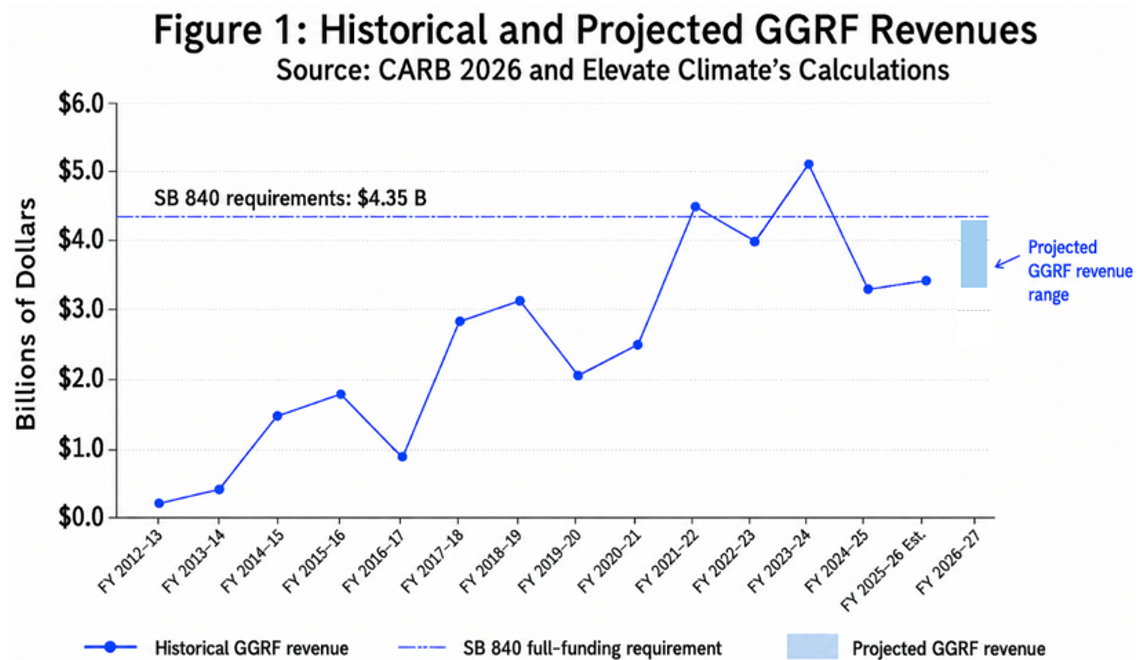
Methodology for Figure 1: historical GGRF revenues are drawn from the California Air Resources Board.[vi] We estimate FY 25-26 revenues by assuming the last quarter of GGRF will be equal to the arithmetic mean of the preceding three quarters. For FY 26-27, we present a range based on two allowance price assumptions: a low case of ~$32.10, equal to the rounded arithmetic average of the floor between 2026 and 2030 under 2% inflation, and high case of $41.76, equal to the program’s historical maximum reached in FY 23-24. We then multiply price cases by the total quantity of estimated GGRF allowances auctioned in FY 26-27, which equals 104.17 million allowances.[vii] Figure 1 visualizes the resulting range of GGRF revenues.
[i] Coalition Letter. 04 August 2026. “Honor SB 840 Commitments to AHSC, TIRCP, LCTOP, AB 617, and SAFER for 2026/27”. Link here.
California Transit Association. 30 July 2026. “Last Chance to Protect Critical Transit Funds in 2026.” Link here.
[ii] Health & Safety Code §39719.4(c)(3) reads: “if, for any fiscal year the Department of Finance determines that, after fully allocating the amounts pursuant to subdivisions (a) and (b), there are insufficient annual proceeds to fully provide for the appropriations specified in paragraph (1) in addition to any state operations costs appropriated in the annual Budget Act, the amounts specified in paragraph (1) shall be proportionally reduced as determined by the Department of Finance.”
[iii] This approximately sums all the SB 840 priorities with explicit values.
[iv] All else equal, lower caps imply that higher prices are needed to maintain the same level of GGRF revenue. As an illustration, Elevate Climate estimates that allowance prices would have to rise to ~$64 to fund all SB 840 priorities between 2027 and 2030. A sharp rise in allowance prices to ~$64 seems highly unlikely to occur in FY 2026-2027, especially given that current allowance prices are around ~$33.
[v] The maximum price of ~$42 was reached during a time predating Trump’s Executive Order, which has since cast a degree of legal uncertainty around the program, and when proposed regulations would have removed up to 265 million allowances.
[vi] California Air Resources Board. 2026. Auction Information. Link here.
[vii] Like the May 2026 auction results, we assume the remaining August and November 2026 auctions offer 26.748 million allowances with proceeds flowing into GGRF. For 2027, we assume this quantity will decrease proportional to the cap decline between 2026 and 2027, which equals 5.28 percent (17 CCR § 95841, Table 6-2), such that February and May 2027 auctions offer 25.335 million allowances with proceeds flowing into GGRF (26.748 million allowances * (1 - .0528)). Summing up the four auctions in FY 26-27, we estimate 104.17 million allowances that yield GGRF revenues, under these assumptions.
contact: clayton@elevateclimate.com